GRID & SILICON LESSONS · LESSON 7
Transformers and Substations: Power at the Right Voltage
Transformers and substations
Read one section at a time. You can look back at this explainer for every question. Open the PDF above to print your work.
How does electricity reach a data center at the right voltage?
In the news
A new AI data center is being built near Robstown, Texas. Before its computers can run, it needs a lot of electricity. In early November 2026, the company building it said work had started on a substation for the site. Following the electricity on its trip shows why that matters.
Look closer
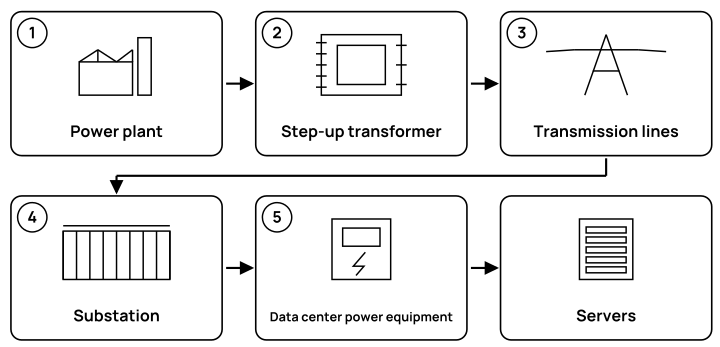
This diagram shows the trip described in 'The trip to a data center'.
From the step-up transformer to the substation, very high voltage lets the current stay low. From the substation on, the voltage is lowered in stages.
Not shown: switches, breakers and the safety fence at the substation (see 'Substations' and 'Staying safe'). Real systems have more steps than this simple diagram.
Start with the whole system
A data center is a building full of computers called servers. Servers run all day and night. They need a steady supply of electricity.
That electricity comes from power plants. A power plant makes electricity. Power lines carry it away. The grid is the large network of power plants, power lines and substations that connects power plants to the people and buildings that use electricity.
Voltage and current
Two words help explain the trip. Voltage is the electric push that moves charge through a wire. Current is how much electric charge flows through a wire each second.
Think of water in a hose. The water pressure is like voltage. The amount of water flowing out each second is like current. Like any model, this one is not perfect, but it helps.
Power is how fast energy is delivered. The same power can be sent in two ways. It can use high voltage with low current. Or it can use low voltage with high current.
Every wire pushes back a little on the current flowing through it. This makes the wire warm. Some energy leaks out of a warm wire as heat. More current makes much more heat. Less current means less energy is lost as heat.
So power lines that go a long way use very high voltage. Then the current can be low, and less energy is wasted along the way. High voltage does not add energy. It is a way to send the same power with less loss.
Transformers
A transformer is a machine that changes the voltage of AC electricity. A transformer does not make electricity. It only changes the voltage. AC means alternating current. In AC, the current flips direction back and forth many times each second. The grid uses AC.
Inside a transformer are two coils. A coil is wire wrapped around and around in loops. The two coils are wound on the same iron core, but they do not touch. AC in the first coil makes a magnetic field that keeps changing. That changing field causes a voltage in the second coil.
The number of loops sets the new voltage. If the second coil has more loops, the voltage goes up. This is called stepping up. If the second coil has fewer loops, the voltage goes down. This is called stepping down.
A step-up transformer near the power plant raises the voltage for the long trip. Step-down transformers lower it again near the places that use the electricity.
Substations
A substation is a fenced site that connects, controls and protects power lines. Many substations have transformers that change the voltage. Some substations do not change the voltage at all. They only connect and control lines.
A switch is a device workers open or close to connect or disconnect a line. Workers might open a switch so a line can be fixed safely.
A breaker is a safety device that opens by itself to stop current when there is a problem. For example, a tree branch might fall on a line. The breaker opens fast. This helps protect people and equipment.
The trip to a data center
Now follow the electricity. First, a power plant makes it. Second, a step-up transformer raises the voltage. Third, high-voltage transmission lines carry it a long way. Transmission lines are the tall power lines that carry electricity long distances.
Fourth, a substation lowers the voltage. A big data center often has its own substation on or near the site. Fifth, power equipment inside the data center gets the electricity ready for the servers.
The voltage is lowered in stages. A stage is one step in a process that has several steps. Each stage lowers the voltage a step closer to what the equipment can use.
Servers cannot use power-line electricity just as it arrives. Power equipment in the data center lowers the voltage and keeps it steady. It also changes AC into DC for the servers. DC means direct current. In DC, the current flows in only one direction. Some power equipment also keeps the servers running for a short time if the grid power stops.
Staying safe
The voltage in transmission lines and substations is high enough to kill. Electricity at that voltage can even jump through the air to a person who gets too close. That is why substations have a fence and warning signs. The fence keeps people a safe distance from the equipment.
Never climb a substation fence or a power pole, even to get a ball. Tell an adult. They can call the power company. Stay far away from any fallen power line. Never try to experiment with wall outlets or power lines.
Words to know
- AC (alternating current)
- Current that flips direction back and forth many times each second.
- DC (direct current)
- Current that flows in only one direction.
- Breaker
- A safety device that opens by itself to stop current when there is a problem.
- Coil
- Wire wrapped around and around in loops.
- Current
- How much electric charge flows through a wire each second.
- Grid
- The large network of power plants, power lines and substations.
- Stage
- One step in a process that has several steps.
- Substation
- A fenced site that connects, controls and protects power lines.
- Switch
- A device workers open or close to connect or disconnect a line.
- Transformer
- A machine that changes the voltage of AC electricity.
- Transmission lines
- The tall power lines that carry electricity long distances.
- Voltage
- The electric push that moves charge through a wire.
Sources
Original source: Hut 8 begins substation work at $399M Beacon Point data center near Robstown · Texas Construction Hub · November 5, 2026