
GRID & SILICON LESSONS · LESSON 8
Cooling Towers and Dry Coolers: Where Data Center Heat Goes
GRID & SILICON TECHNOLOGY EXPLAINER Cooling Towers and Dry Coolers: Where Data Center Heat Goes
How does a data center move heat outside, and how much water does it use?
In the news
Computers make heat
A data center is a building full of computers called servers. Each server has chips. A chip is a small part that does the computer's work. Chips use a lot of electricity. Almost all the electricity a chip uses turns into heat. If a chip gets too hot, it can slow down or break. So the heat must be carried away all day and all night.
Heat moves from hot to cold
Heat is energy that moves from a warmer thing to a cooler thing. Heat always moves from a warmer place to a cooler place. A cooling system uses this rule again and again. Hold an ice cube in your hand. Heat moves from your warm hand into the cold ice. Your hand feels cold, and the ice melts.
Inside: from the chip to the coolant loop
Some servers are cooled by fans that blow air over the chips. But many new AI chips get too hot for air alone. They are cooled with liquid instead.
A cold plate is a flat metal block that sits on top of a chip. Cool liquid flows through thin channels inside it. Heat moves from the hot chip into the metal and then into the liquid. This liquid is called coolant. Coolant is a liquid that carries heat away from hot parts. Pumps push the warm coolant through pipes.
The pipes make a coolant loop. A coolant loop is a closed path of pipes that the same coolant flows around again and again. The coolant picks up heat at the chips and gives off heat outside. Then it comes back cool. Because the loop is closed, the coolant is used again and again. Outside, one of two machines moves the heat into the air. One is a cooling tower. The other is a dry cooler.
Grid & Silicon · Learn Page 1 of 4
Cooling towers
Evaporate means to change from a liquid into a gas. When water evaporates, it becomes water vapor. Water vapor is water in the form of a gas.
Water takes in a lot of heat when it evaporates. Think about getting out of a pool. The water on your skin evaporates. It takes heat from your skin, so you feel cold.
A cooling tower is a machine that cools by letting water evaporate into the outside air. In one common kind, warm coolant flows through pipes inside the tower. Water is sprayed over the pipes. Fans pull air through. Some of the sprayed water evaporates and carries heat away. The cooler coolant flows back to the servers.
The water that evaporates leaves as vapor in the air. It does not come back. That water is used up.
When water evaporates, its minerals stay behind. Over time, the leftover water gets too full of minerals. Blowdown is water drained from a cooling tower because it has too many minerals. Fresh water replaces the water lost to evaporation and blowdown.
Cooling towers need very little electricity. But on hot days, they can use a lot of water.
Dry coolers
A dry cooler is a machine that cools the coolant with fans and outside air, without evaporating water. Inside, warm coolant flows through metal tubes with thin metal fins. Fans blow outside air across the fins. Heat moves from the warm coolant into the cooler air.
A dry cooler uses little or no water. But it works best when the outside air is much cooler than the coolant. On a hot day, less heat moves into the warm air. The fans work harder, and some data centers turn on machines that work like big air conditioners. On hot days, a dry cooler can use more electricity.
Some data centers use dry cooling most of the year and add a little water on the hottest days.
Water or electricity: a tradeoff
A tradeoff is when you give up some of one thing to get more of another thing. Cooling towers save electricity but use more water. Dry coolers save water but can use more electricity on hot days.
Making electricity can use water too. Some data centers build their own power plants, and those plants also use a lot of water.
Grid & Silicon · Learn Page 2 of 4
A researcher told CNBC that the biggest AI data centers can use up to 10 million gallons of water a day. That number is an estimate. The real amount depends on the machines, the place and the weather. Engineers choose the cooling that fits each place.
Key ideas
• Almost all the electricity a chip uses turns into heat.
• Heat always moves from a warmer place to a cooler place.
• A coolant loop carries heat from the chips to a machine outside. The coolant is used again and again.
• A cooling tower uses water: the water that evaporates leaves as vapor and does not come back.
• A dry cooler uses little or no water, but it can use more electricity on hot days.
Words to know
Blowdown: Water drained from a cooling tower because it has too many minerals.
Cold plate: A flat metal block on top of a chip. Coolant flows through it.
Coolant: A liquid that carries heat away from hot parts.
Coolant loop: A closed path of pipes that the same coolant flows around again and again.
Cooling tower: A machine that cools by letting water evaporate into the outside air.
Dry cooler: A machine that cools with fans and outside air, without evaporating water.
Evaporate: To change from a liquid into a gas.
Heat: Energy that moves from a warmer thing to a cooler thing.
Tradeoff: Giving up some of one thing to get more of another thing.
Water vapor: Water in the form of a gas.
Try it: feel evaporation (safe, with an adult)
Wet a paper towel with plain room-temperature tap water. Lay it on the back of your hand. Gently fan it with a sheet of paper. Your skin feels cooler as the water evaporates and carries heat away. Now try a dry paper towel. Which one feels cooler?
Grid & Silicon · Learn Page 3 of 4
The path of the heat
This diagram shows the path in the sections about the coolant loop, cooling towers, and dry coolers.
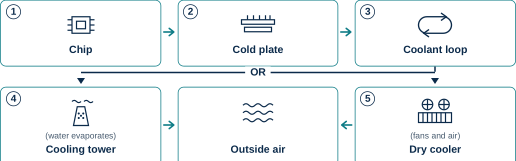
Heat moves from the chip into the cold plate, then into the coolant. The coolant loop carries the heat outside. A cooling tower moves it into the air by letting water evaporate. A dry cooler uses fans and air instead.
Not shown: pumps, the return pipes, and the fresh water added to a cooling tower. Real data centers often have more than one loop and more steps than this simple diagram.
Original source
Voters rejected AI data centers over resource concerns.
Here's why measuring water usage is hard
CNBC · November 5, 2026
https://www.cnbc.com/2026/11/05/ meta-spacex-ai-data-centers-use- millions-of-gallons-of-water-a-day.html
For teachers and parents: scan the code to print the article or read it aloud. Students do not need the article to answer the questions.
About the news story
On November 5, 2026, CNBC reported on how much water large AI data centers use. Many new AI data centers cool their chips with a closed loop of liquid that uses very little water each day. Most water is used outside, where the heat is sent into the air. Dry cooling uses far less water but can use far more electricity, especially in hot places. Evaporative cooling uses little electricity but can lose a lot of water on the hottest days. Many data centers mix the two.
Grid & Silicon · Learn Page 4 of 4