
GRID & SILICON LESSONS · LESSON 8
Teacher and parent guide
GRID & SILICON TEACHER AND PARENT GUIDE Cooling Towers and Dry Coolers: Where Data Center Heat Goes
How does a data center move heat outside, and how much water does it use?
About 30–40 minutes · Main target grade 6 (works for grades 4–8) · Explainer written at about a grade 5 reading level
What students will learn
• Explain that almost all the electricity a chip uses turns into heat, and that heat moves from warmer to cooler.
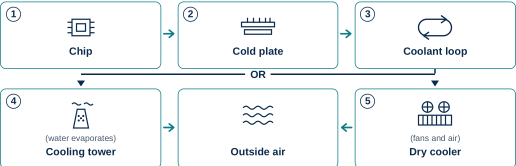
• Trace the path of heat from a chip, through a cold plate and a coolant loop, to the outside air, using a
diagram.
• Explain how a cooling tower moves heat: some water evaporates and leaves as vapor, so that water is used
up.
• Explain how a dry cooler moves heat with fans and air, and why it can use more electricity on hot days.
• Describe the tradeoff between water and electricity when choosing a cooling method.
Supplies
The explainer (4 pages), the student sheet (4 pages, two sheets printed on both sides), a pencil and an eraser. A highlighter is optional.
How to use it
• This lesson is for one student working alone. A partner or an adult is optional, never required. The student
may read the explainer alone, or an adult may read every word aloud, including the questions.
• Each question can be answered from the explainer alone. Students do not need the Word of the Week box or
the glossary. The section names in the answer key show where to look. You may point the student to a section if they get stuck.
• Students may draw or write in the warm-up boxes. Short or spoken answers are fine; an adult may write
down what the student says. Privacy: use initials only on the sheet.
• Optional roles if a partner or an adult joins: one person reads the explainer aloud while the student follows
along; then the student answers while the other person listens. Switch if you like.
• Break it up if needed: explainer one day, questions the next. The word search can be done last or on its own.
• Optional demo (safe, no heat or electricity): wet a paper towel with room-temperature tap water, lay it on the
student's hand, and fan it. Compare with a dry towel. See the section about cooling towers. Use only plain tap water.
Grid & Silicon · Learn Page 1 of 7
Answer key
Warm-ups
Warm-up A: Why does a data center need to carry heat away from its chips?
Answer: If a chip gets too hot, it can slow down or break. Drawings that show this idea are fine.
In the section “Computers make heat”: “If a chip gets too hot, it can slow down or break.”
Warm-up B: Why do you feel cold right after you get out of a pool?
Answer: The water on your skin evaporates and takes heat from your skin. Drawings that show this idea are fine.
In the section “Cooling towers”: “It takes heat from your skin, so you feel cold.”
Word of the Week
Evaporate: To change from a liquid into a gas. Accept any sentence that uses the word correctly. Example: The puddle will evaporate when the sun comes out.
Part 1: Multiple choice
1. A chip uses electricity. What does almost all of that electricity turn into?
Answer: B. Heat
In the section “Computers make heat”: “Almost all the electricity a chip uses turns into heat.”
2. You hold an ice cube in your warm hand. Which way does the heat move?
Answer: A. From your hand into the ice
In the section “Heat moves from hot to cold”: “Heat moves from your warm hand into the cold ice.”
3. What does a cold plate do?
Answer: C. It moves heat from the chip into the coolant
In the section “Inside: from the chip to the coolant loop”: “Heat moves from the hot chip into the metal and then into the liquid.”
4. Why is the coolant in a coolant loop not used up?
Answer: B. It is a closed loop, so the same coolant is used again and again
In the section “Inside: from the chip to the coolant loop”: “Because the loop is closed, the coolant is used again and again.”
5. How does a cooling tower carry heat away?
Answer: A. Some of the sprayed water evaporates and takes the heat with it
In the section “Cooling towers”: “Some of the sprayed water evaporates and carries heat away.”
6. What happens to the water that evaporates in a cooling tower?
Answer: C. It leaves as vapor in the air and does not come back
In the section “Cooling towers”: “The water that evaporates leaves as vapor in the air.”
Grid & Silicon · Learn Page 2 of 7
7. Why is some cooling tower water drained away as blowdown?
Answer: C. It has too many minerals
In the section “Cooling towers”: “Over time, the leftover water gets too full of minerals.”
8. It is a very hot day. What can happen with a dry cooler?
Answer: B. It can use more electricity
In the section “Dry coolers”: “On hot days, a dry cooler can use more electricity.”
9. Which sentence shows the tradeoff?
Answer: B. Cooling towers save electricity but use more water
In the section “Water or electricity: a tradeoff”: “Cooling towers save electricity but use more water.”
Part 2: Fill in the blanks
1. A liquid that carries heat from hot parts is coolant .
In the section “Inside: from the chip to the coolant loop”: “Coolant is a liquid that carries heat away from hot parts.”
2. When water evaporates, it becomes water vapor .
In the section “Cooling towers”: “When water evaporates, it becomes water vapor.”
3. Heat moves from a warmer place to a cooler place.
In the section “Heat moves from hot to cold”: “Heat always moves from a warmer place to a cooler place.”
4. Saving water but using more power is a tradeoff .
In the section “Water or electricity: a tradeoff”: “A tradeoff is when you give up some of one thing to get more of another thing.”
Grid & Silicon · Learn Page 3 of 7
Part 3: Label the diagram
Answers: 1. Chip; 2. Cold plate; 3. Coolant loop; 4. Cooling tower; 5. Dry cooler. The last box, Outside air, is already labeled.
These steps are described in the sections “Computers make heat,” “Inside: from the chip to the coolant loop,” “Cooling towers,” and “Dry coolers.” Labels 4 and 5 are told apart by the pictures: the cooling tower shows water drops and vapor and the caption (water evaporates); the dry cooler shows two large fans and the caption (fans and air).
Part 4: Think about it
1. Which uses more water, a cooling tower or a dry cooler? Explain why.
Sample answer: A cooling tower uses more water. It cools by letting water evaporate, and the water that evaporates leaves as vapor and does not come back. A dry cooler uses fans and air, not evaporating water. Section: Cooling towers (also accept Dry coolers or Water or electricity: a tradeoff if the answer uses that section's idea).
In the section “Cooling towers”: “The water that evaporates leaves as vapor in the air. It does not come back.”
2. A town has very little water. Which machine would you pick? What is the tradeoff?
Sample answer: A dry cooler, because it uses little or no water. The tradeoff is that it can use more electricity on hot days. (A cooling tower answer earns credit only if the student explains the water cost.)
In the section “Water or electricity: a tradeoff”: “Dry coolers save water but can use more electricity on hot days.”
Accept answers in the student's own words. Scoring idea (2 points each): 1 point for the main idea, 1 point for a reason that matches the explainer. Question 1: the key link is that evaporated water leaves as vapor and does not come back; also check that the student named a supporting section (Cooling towers, Dry coolers, or Water or electricity: a tradeoff). Question 2: a machine choice with a reason, plus the tradeoff (dry cooler: more electricity on hot days; cooling tower: uses more water).
Grid & Silicon · Learn Page 4 of 7
Word search answer key
Every word is in the explainer. Shaded letters mark the 10 hidden words. Words go across, down, or diagonally down to the right. None are backwards.
| F | T | B | Q | R | Y | B | S | L | K | X | F | N |
| B | B | B | Z | W | B | Q | J | R | B | V | K | S |
| T | W | C | O | O | L | A | N | T | K | P | K | K |
| S | M | B | B | L | O | W | D | O | W | N | R | W |
| Z | F | H | Z | M | F | T | N | V | F | I | N | S |
| R | V | H | J | M | M | R | X | T | V | Q | X | S |
| C | T | E | K | E | V | A | P | O | R | A | T | E |
| Q | R | A | H | P | W | D | C | P | D | S | V | R |
| F | H | T | V | Q | P | E | T | H | B | T | C | V |
| M | T | O | W | E | R | O | Y | X | I | X | Q | E |
| Z | H | H | V | K | B | F | J | W | W | P | K | R |
| Q | V | P | X | P | S | F | L | W | Y | B | Q | V |
| G | V | W | J | R | C | T | P | L | O | O | P | X |
EVAPORATE — row 7, column 5, across SERVER — row 6, column 13, down
COOLANT — row 3, column 3, across CHIP — row 8, column 8, diagonal
TOWER — row 10, column 2, across HEAT — row 6, column 3, down
BLOWDOWN — row 4, column 4, across LOOP — row 13, column 9, across
TRADEOFF — row 5, column 7, down FINS — row 5, column 10, across
Grid & Silicon · Learn Page 5 of 7
Standards
This is a short reading lesson. It supports parts of the standards below. It does not by itself meet a full NGSS performance expectation, because students do not develop their own model, collect data or design a solution.
Common Core, grade 6 and grades 6–8 science literacy (practiced here; RI.6.1 supported in part, not fully assessed) CCSS.ELA-LITERACY.RI.6.1: Cite textual evidence to support analysis of what the text says explicitly as well as inferences drawn from the text.
Where: Supported (partial): Think about it 1 asks students to name the section of the explainer that supports their answer. Other items also ask students to use ideas from the text. Formal quotation and multi- step inference are not assessed, so RI.6.1 is not fully met.
CCSS.ELA-LITERACY.RST.6-8.4: Determine the meaning of symbols, key terms, and other domain-specific words and phrases as they are used in a specific scientific or technical context relevant to grades 6–8 texts and topics.
Where: Word search, Word of the Week, Part 2.
CCSS.ELA-LITERACY.RST.6-8.7: Integrate quantitative or technical information expressed in words in a text with a version of that information expressed visually (e.g., in a flowchart, diagram, model, graph, or table).
Where: Part 3 diagram labeling.
CCSS.ELA-LITERACY.L.6.6: Acquire and use accurately grade-appropriate general academic and domain- specific words and phrases; gather vocabulary knowledge when considering a word or phrase important to comprehension or expression.
Where: Word of the Week sentence; word search.
NGSS middle school (supports only; no performance expectation is met)
Disciplinary core idea PS3.B (as listed with MS-PS3-3): Energy is spontaneously transferred out of hotter regions or objects and into colder ones.
Where: Supported: Q2, Part 2 item 3, and the heat path in Part 3. MS-PS3-3 itself reads: “Apply scientific principles to design, construct, and test a device that either minimizes or maximizes thermal energy transfer.” Students do not design, build or test a device, so MS-PS3-3 is NOT met. A follow-up design task (for example, testing which cover keeps a cup of ice from melting) would be needed.
Crosscutting concept: Energy and Matter (as listed with MS-PS3-3): The transfer of energy can be tracked as energy flows through a designed or natural system.
Where: Supported: students track heat from the chip to the outside air (Part 3, Q3–Q5).
Grid & Silicon · Learn Page 6 of 7
Disciplinary core idea ESS3.C (as listed with MS-ESS3-3 and MS-ESS3-4): Typically as human populations and per-capita consumption of natural resources increase, so do the negative impacts on Earth unless the activities and technologies involved are engineered otherwise.
Where: Supported (partial): students compare how two cooling technologies use water and electricity (Q6– Q9, Think about it 1–2). MS-ESS3-3 asks students to design a method for monitoring and minimizing a human impact, and MS-ESS3-4 asks them to construct an evidence-based argument about population and resource use. This lesson does neither in full, so neither performance expectation is met. Think about it 2 is a small first step toward MS-ESS3-3 reasoning about reducing water use.
Note on numbers: the only water amount in the lesson (up to 10 million gallons a day for the biggest AI data centers) is an estimate from a researcher quoted by CNBC. Real use varies a lot by site, weather and cooling method. It is not assessed.
Sources
• CNBC, “Voters rejected AI data centers over resource concerns. Here's why measuring water usage is hard,”
November 5, 2026. https://www.cnbc.com/2026/11/05/meta-spacex-ai-data-centers-use-milli ons-of-gallons-of-water-a-day.html
• U.S. Department of Energy, Federal Energy Management Program, “Best Management Practice #10: Cooling
Tower Management.” https://www.energy.gov/femp/best-management-practice-10-cooling-tower-management
• Next Generation Science Standards, MS-PS3-3.
https://www.nextgenscience.org/pe/ms-ps3-3-energy
• Next Generation Science Standards, MS-ESS3-3.
https://www.nextgenscience.org/pe/ms-ess3-3-earth-and-human-activity
• Common Core State Standards, Reading Informational Text, Grade 6.
https://www.thecorestandards.org/ELA-Literacy/RI/6/
• Common Core State Standards, Science and Technical Subjects, Grades 6–8.
https://www.thecorestandards.org/ELA-Literacy/RST/6-8/
• Common Core State Standards, Language, Grade 6.
https://www.thecorestandards.org/ELA-Literacy/L/6/
Grid & Silicon · Learn Page 7 of 7